
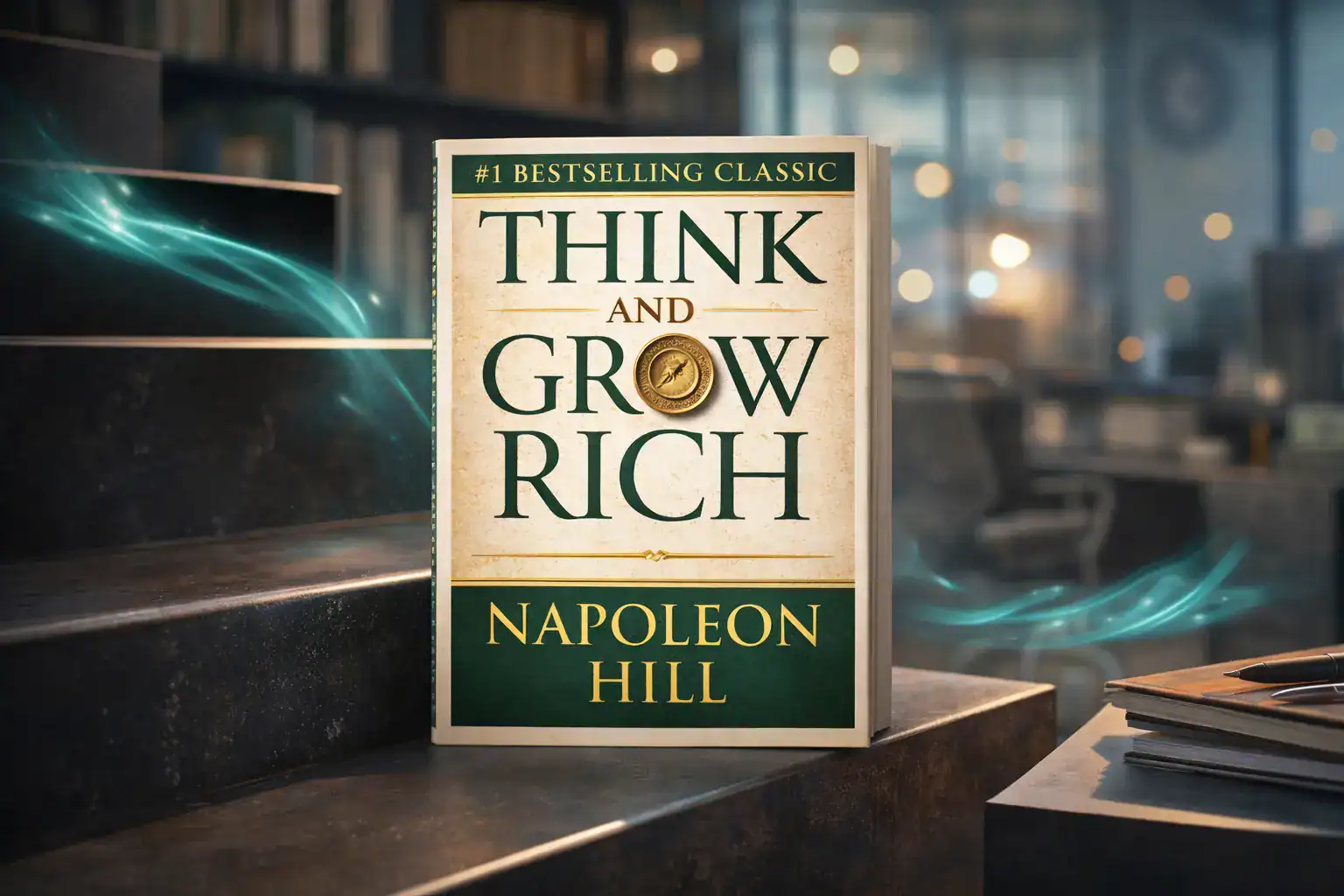
Think and Grow Rich by Napoleon Hill: Full Summary, Core Ideas, and Practical Takeaways
Napoleon Hill’s Think and Grow Rich is a classic book about success, wealth, and the mental habits Hill believed shape achievement. This detailed Think and Grow Rich book summary will help you understand the main ideas, chapter flow, and practical lessons without having to read the entire book.
Published in 1937, Think and Grow Rich presents Hill’s central claim that lasting success begins in the mind. It is supported by desire, belief, planning, decision, persistence, and organized effort. The book is not just about money; Hill uses “riches” broadly to include achievement, purpose, and a stronger life overall. As a full summary, this post follows the book’s original 13 principles, so the progression feels faithful to Hill’s intent and easy to follow.
Desire: The Starting Point of All Achievement
Hill begins with desire because he treats it as the real starting point of every meaningful result. What this really means is that a vague wish is not enough; the mind must lock onto a definite goal with emotional intensity. The book’s famous idea is that a “burning desire” gives direction to thought and action, turning scattered interest into focus. Hill writes:
“Desire is the starting point of all achievement.”
and
“Whatever the mind can conceive and believe, it can achieve.”
In practical terms, this chapter teaches that clarity matters before effort. A person who knows exactly what they want can organize their thoughts and energy more effectively than someone chasing several goals at once. A timeless saying fits Hill’s point well: “Where there is no vision, the people perish.” The chapter connects directly to everything that follows, because the rest of the book shows how desire gets transformed into belief, plans, and action.
Faith and Auto-Suggestion
Hill’s next two ideas are faith and auto-suggestion, and they work together. Faith is the belief that the goal is possible, while auto-suggestion is the repeated feeding of that belief to the subconscious mind. The author shows that repeated thought is not idle repetition in his system. It is a way of training inner expectation so that behavior begins to match the goal. Hill describes faith as “the head chemist of the mind,” and he presents auto-suggestion as the bridge between conscious desire and subconscious conviction.
This matters because people often stop short of action when they do not truly believe they can succeed. Hill’s logic is that doubt weakens commitment, while belief strengthens it. In real life, the point is not empty positive talk; it is steady mental reinforcement of a clear purpose. The old saying “As a man thinketh, so is he” fits Hill’s argument because the book keeps returning to the idea that inner thought shapes outer result.
Specialized Knowledge and Imagination
Hill then shifts from inner attitude to the kind of knowledge that actually supports achievement. Specialized knowledge is not endless information; it is practical, focused knowledge that serves a definite purpose. Imagination comes next because knowledge alone does not create results unless it is arranged into an idea or plan. Hill treats imagination as the workshop where desire becomes something usable, and that connection is crucial to the book’s structure.
In plain language, Hill is saying that useful knowledge must be selected, organized, and applied. This is why he does not praise intelligence in the abstract; he values the mind that can combine facts into a workable solution. This section bridges belief and action, because imagination gives form to the goal before organized planning turns it into a reality. A universal idea here is that:
“Knowledge is of no value unless you put it into practice.”
Organized Planning and Decision
Organized planning is where Hill moves from thought to method. Once desire is clear and imagination has shaped a possible path, the next step is to build a plan and work it with discipline. Decision matters here because hesitation delays results, and Hill treats procrastination as a major obstacle to success. One of the book’s practical lessons is that a goal becomes serious only when it is translated into concrete steps.
This chapter summary is important because Hill is not offering fantasy; he is building a sequence. Desire without planning stays emotional, and planning without decision stays theoretical. The author emphasizes decisive action because progress depends on movement, not endless reconsideration. In everyday life, this means choosing a direction, writing the plan, and acting before confidence becomes perfect.
Persistence and the Master Mind
Persistence is one of the strongest themes in the book, and the Master Mind principle adds a social dimension. Hill argues that setbacks are normal, but persistent effort keeps belief alive long enough for success to appear. The Master Mind idea says that one mind can benefit from the harmony of other minds working toward the same definite purpose. Hill writes that a mastermind alliance is:
“An alliance of two or more minds working in perfect harmony for the attainment of a common definite objective.”
This matters because the book does not present success as a lonely struggle. Hill sees cooperation as a force multiplier, especially when combined with persistence. A fitting saying is:
“If at first you don’t succeed, try, try again.”
Because the chapter treats repeated effort as part of the method, not as a sign of failure. This section connects back to the earlier principles by showing that inner conviction must survive resistance and be supported by other people when possible.
The Remaining Principles
Hill’s later principles expand the system rather than replace it. He covers sex transmutation, the subconscious mind, the brain, and the sixth sense. Each one extends the same basic idea that thought, emotion, and direction can be organized toward achievement. In Hill’s framework, the subconscious mind stores and processes the repeated mental material fed to it. Meanwhile, the brain and sixth sense represent deeper faculties of insight and intuition. The progression matters because the book keeps moving from intention to inner conditioning to higher awareness.
These sections are sometimes the most misunderstood, but the author’s intent is consistent: a person must learn to govern mental energy and channel it constructively. Even when the language feels dated, the structure is clear. Hill wants the reader to see success as a coordinated process involving desire, belief, repetition, thought organization, and disciplined use of the mind. That is the core of the book’s full summary and one reason it has remained influential in self-help and success literature.
Core Ideas Across Book
The main ideas across Think and Grow Rich are remarkably consistent. First, a clear desire gives direction. Second, belief and repetition help that desire take root. Third, specialized knowledge, imagination, and planning turn inner purpose into a practical route forward. Fourth, persistence and the Master Mind keep the effort alive when obstacles appear.
Taken together, Hill’s message is that success starts internally but must end in organized action. He does not present wealth or achievement as accidental; he treats them as the result of a trained mind working toward a definite goal. That is why the book still gets attention in psychology-focused discussions of motivation, habit, and self-direction.
Practical Applications
In daily life, Hill’s ideas can be applied in simple, realistic ways. A reader can start by choosing one definite goal, writing it clearly, and reviewing it regularly to keep the desire focused. Then they can reinforce that goal through repeated reflection, visualization, and deliberate self-talk, which mirrors Hill’s auto-suggestion principle. After that, the goal should be broken into a workable plan with a decision deadline, because thinking without commitment stays inactive.
The Master Mind principle can be applied by surrounding yourself with people who support clear goals and honest feedback. Persistence matters most when progress slows, because Hill’s method assumes that difficulty is part of the process rather than proof of failure. The practical takeaway is not magical thinking; it is disciplined mental focus joined to steady action.
Final Summary
Think and Grow Rich is a book summary of success as a mental and practical process, not a quick formula. Its key lessons are that desire must be definite, belief must be cultivated, action must be planned, and persistence must outlast obstacles. Hill’s main ideas remain influential because they give readers a structured way to think about purpose, confidence, and follow-through.
Read as a whole, the book is a chapter-by-chapter guide to turning intention into achievement. Its strongest insight is that what happens in the mind shapes what happens in life, but only when thought is backed by decision and effort. That combination is the heart of Hill’s message and the reason the book continues to be discussed as a classic in personal development.
FAQs:
Think and Grow Rich is a personal development book by Napoleon Hill that explains how focused desire, belief, and persistent action can help you achieve your goals. It lays out a step‑by‑step philosophy for turning ideas into tangible results.
Yes. While some examples are dated, the core ideas in Think and Grow Rich—clarity of goals, building a “Master Mind” group, disciplined planning, and persistence—are timeless. Many entrepreneurs and professionals still use these principles to guide their careers and businesses.
The main principles include desire, faith, auto‑suggestion, specialized knowledge, imagination, organized planning, decision, persistence, the Master Mind, transmutation of energy, the subconscious mind, the brain, and the sixth sense. This Think and Grow Rich book summary highlights how each principle connects and how you can use them in real life.
Start by writing a clear, specific goal, then create a simple written plan of daily actions toward it. Use positive self‑talk (auto‑suggestion), track your progress, and surround yourself with a small group of people who support your goal (your Master Mind). Review your plan regularly and adjust instead of quitting when setbacks appear.




No comments yet. Be the first to share your thoughts!