
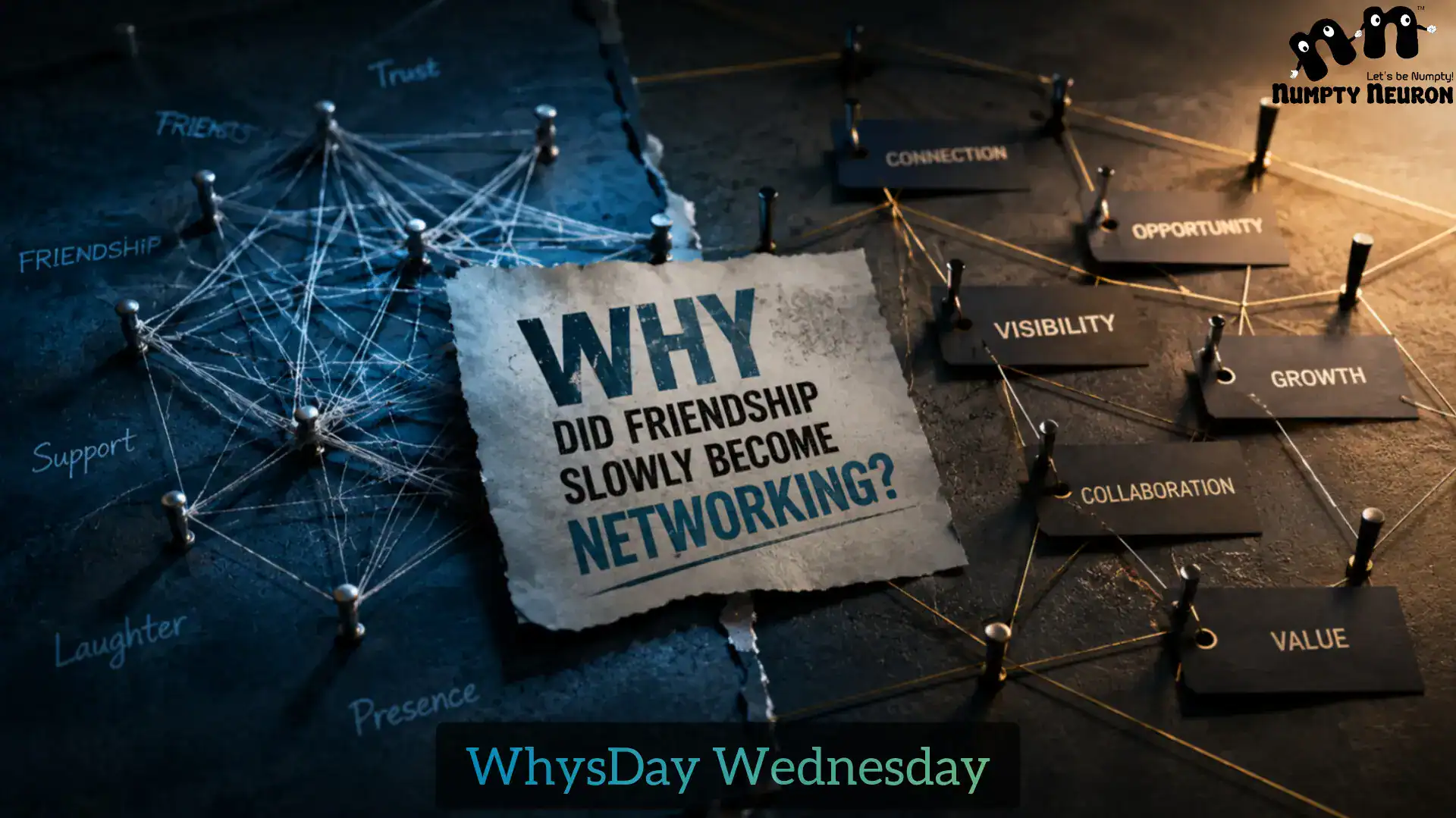
Why Did Friendship Slowly Become Networking?
In every WhysDay Wednesday, we usually pick one “why” and go deep into it.
But today… We couldn’t choose just one. Because sometimes, it’s not a single question that’s been bothering us. It’s a pattern we’ve all been quietly noticing.
When “Let’s Catch Up Soon” Never Really Happens
Here are the ones we couldn’t ignore:
– Why did friendship slowly become networking⁉️
– Why did “come over anytime” or “dropping by a friend’s house” turn into “let’s plan next week”⁉️
– Why do people feel awkward talking to strangers today when it once felt normal⁉️
– Why do we know hundreds of people online but barely know our neighbors⁉️
– Why did human connection become scheduled instead of natural⁉️
– Why do trains, buses, and waiting rooms now feel quieter than libraries when they once carried stories and laughter⁉️
– Why did deep conversations get replaced by reels, memes, and short replies⁉️
– Why did hanging out become “too much effort” or “extra work” for modern friendships⁉️
You scroll, reply, react… and still feel a little alone.
Why do we feel lonely, avoid eye contact, and cancel real plans even when we miss people?
In today’s WhysDay Wednesday, we’re going deeper into what’s really changed.
– It’s in the “let’s catch up next week” that never happens.
– In the call you almost made… but didn’t.
– In the plans you cancel, then spend hours online anyway.
It doesn’t look like a disconnection. But it quietly feels like it. When did connecting start feeling like an effort? And when did we start holding back so much? And if you’re curious to understand what’s really behind all of this… You might want to read further in the full article.
From Just Showing Up to Planning Weeks in Advance
There was a time when you could just show up at someone’s door.
No message. No planning. No checking if it was “a good time.” And somehow, it usually was.
Now we pause before even sending a text. We think about timing. Tone. How it might be received. Whether it feels random. Whether we are being too much.
And slowly, without realizing it, something changed.
When Friendship Starts to Feel Like a To‑Do List
We often say life got busier. Or that technology made us distant. But the deeper shift is quieter. And more personal. We stopped showing up as we are. We started showing up as we want to be seen. And that changes everything.
Friendship did not just become networking because of careers or ambition. It happened because every interaction now carries a quiet pressure. To be interesting enough. To be appropriate enough. To be remembered the right way. Somewhere along the way, being known started to feel more risky than being liked.
Why Your Brain Keeps Picking the Screen Over People
And this is where the modern contradiction begins. We can spend hours online without feeling tired. But cancel a real-life plan in seconds.
We say we miss how things used to feel. But rarely slow down enough to rebuild it. We feel lonely more often. Yet avoid eye contact with the person sitting right next to us. It sounds confusing on the surface. But it makes sense when you look a little deeper.
Online, you are in control. You can respond when you want. You can edit what you say. You can leave without explanation. You can be present without being fully seen.
Real life does not offer that. It asks for your attention. Your energy. Your unfiltered self. And that feels heavier, especially when you have spent most of your time managing how you come across.
So the brain quietly starts choosing what feels easier, not what feels deeper.
Scrolling Is Easy. Showing Up Is Hard.
Think about this for a moment.
Scrolling is an effortless connection. Being with someone is an active connection. One numbs loneliness for a while. The other actually touches it. And when you are already mentally tired, you choose what asks less from you.
Not because you do not care. But because you have trained yourself to conserve emotional energy.
How Growing Up Quietly Pulled You Away from Your Closest People
This also explains something else we rarely talk about.
Why does adulthood slowly separate even the closest friends? It is not always distance. It is not always a lack of love.
It is that life becomes more structured, and so do we. We start managing time, responsibilities, and roles. And slowly, we begin managing ourselves in relationships, too. We wait for the “right time” to reach out. We do not want to interrupt. We assume they are busy.
And without realizing it, we replace natural closeness with polite distance. No conflict. No breakdown. Just a quiet drifting.
The Places Where Conversation Used to Live
The same pattern shows up everywhere.
In trains that used to carry conversations but now carry silence. In waiting rooms where people sit inches apart but feel miles away. In small moments where eye contact is avoided, not because we do not see each other, but because we do. And being seen, even for a second, feels unexpectedly vulnerable. So we look down. We scroll. We stay in our own contained space.
The Strangers You Almost Talk To (But Don’t)
But this does not just affect old relationships. It affects the ones that never begin.
The stranger you could talk to. The person you could help. The conversation that almost started. You feel the impulse. And then comes the pause.
“What if it is awkward?” “What if they misunderstand?” “What if I am overstepping?”
So you stay quiet. And a connection that could have existed… disappears before it even begins.
All the Tiny Moments We Trade for One More Scroll
Picture this.
You are sitting somewhere, casually scrolling. Time passes easily. Almost unnoticed. Later, you have plans to meet someone. And suddenly, it feels like effort. Getting ready feels like an effort. Talking feels like an effort. Showing up fully feels like effort.
So you cancel.
Not because you do not value the person. But because somewhere along the way, you got used to a version of connection that does not require much from you.
A Life That Looks Full but Still Feels a Little Empty
Here is the part most people do not notice.
We did not lose the desire for connection. We lost our tolerance for the effort and uncertainty that comes with it.
So we built a life that feels socially full but emotionally light. And over time, that lightness starts to feel like emptiness.
Questions to Ask Yourself When You Feel Disconnected
Pause for a second and sit with this.
How many moments of connection in your life never happened… simply because you hesitated? How often do you choose what feels easy in the moment over what feels meaningful in the long run?
And if you are honest…
Do you feel disconnected because people are unavailable, or because something in you has learned to hold back?
Maybe nothing is “wrong” with this generation. Maybe we just became more careful. More self-aware. More protective of our time and energy.
But in that process, we also became a little distant from the very thing we are all looking for. Careful is not the same as close.
Small Experiments to Feel Closer to People Again
And maybe the shift does not require something big or dramatic.
Maybe it starts with something simple.
Seeing your friends a little more often. Saying yes when it feels easier to cancel. Letting weekends hold people, not just recovery. Calling instead of postponing. Sitting together without needing a reason.
Because the truth is, these moments do more than just “pass time.” They regulate you.
They ground you. They remind you who you are outside of roles and responsibilities. They give your mind a place to rest that scrolling never will.
Laughter in a room. Unplanned conversations. Even comfortable silence next to someone. These are not small things. They are what make life feel like life.
One Day You’ll Look Back: What Will Actually Matter?
And one day, much later, work will slow down. Deadlines will stop. The constant chase will be quiet. And the question that tends to surface is rarely about what you achieved. It is softer than that.
“Did I spend enough time with the people who mattered?” “Did I actually live those moments… or just move past them?”
That is not a heavy thought. Just an honest one.
If This Hit Home, You’re Definitely Not the Only One
So maybe try this, gently.
Meet a friend this week, even if it feels like an effort. Stay a little longer than planned. Look up more. Smile more. Start something small. Let people take up space in your time again. Not perfectly. Not all at once. Just a little more than before.
And if something in this made you pause, not just think but feel, it might be worth exploring that space within you a bit more.
Sometimes, understanding how we connect with others quietly changes how we experience everything else, too.
And if you’re curious about the kind of thoughts we don’t usually stop to question but probably should, you can explore more and stay connected with us at Numpty Neuron.
FAQs:
You can feel disconnected from friends even when you’re constantly messaging because most of your connection is happening through screens, not shared experiences. Chats, likes, and reactions give your brain quick hits of social contact, but they don’t provide the depth, safety, and presence that come from being together in real life. Over time, this gap makes friendships feel strangely hollow, even when nothing is obviously “wrong.”
Yes, it’s more common than people admit. Your calendar, group chats, and notifications can look full, while your inner life feels empty. When most interactions are scheduled, rushed, or happening in parallel with scrolling, your nervous system never really rests in the feeling of “being with someone.” The loneliness comes from a lack of emotional depth and unplanned moments—not from a lack of names in your contact list.
Friendship starts to feel like networking when conversations subtly shift from “How are you really?” to “What are you doing?” or “How can this be useful?” Instead of being a place where you can be unpolished and honest, the relationship becomes another area where you have to perform, update, and impress. This makes you feel disconnected from friends because you’re not showing up as your full self—you’re showing up as a version that looks good on the surface.
Start with small, honest changes. Choose one friend to see in person this week, even if it feels inconvenient. Put your phone away for part of that time so your brain can register real presence. Send one message that goes beyond “What’s up?” and shares something you’re genuinely thinking or feeling. These gentle, intentional moments slowly retrain your mind and body to experience deeper connection, instead of only fast, surface-level contact.


No comments yet. Be the first to share your thoughts!