

Why Do I Want Something Different But Can’t Explain What That Is⁉️
Have you ever caught yourself wanting something different, but couldn’t even explain what it is? You feel the pull, the curiosity, but it’s like the answer is just out of reach.
Then, today’s “WhysDay Wednesday” at Numpty Neuron is not to be missed.
It’s a strange mix of excitement and uncertainty, and almost everyone experiencing it doesn’t talk about it openly. Yet, noticing it can be the first step toward discovering what really matters to you, and what could shape your next move.
What’s actually happening when someone says:
“I want something different… but I can’t explain what that is.”
And in 2025-26, it’s extremely common, especially among ambitious, high-functioning professionals.
1. The World Moved Faster Than You Processed
The market shifted. AI accelerated. Personal brands became currency. Career paths became nonlinear. You’re exposed daily to people reinventing themselves, building startups, monetizing niche skills, and automating their work.
Your mind absorbed all of that. But your identity didn’t update at the same speed.
Exposure expands desire before it expands clarity.
You’re seeing possibilities you were never trained for. You were prepared for stability. Now you’re surrounded by reinvention. So internally you feel pulled, but you don’t yet have language for what you’re pulled toward.
That gap feels like fog. It’s not a lack of direction. It’s identity lag.
2. Psychological Safety vs. Psychological Growth
Here’s the uncomfortable part.
Nothing may be dramatically wrong in your life. The job is fine. The income is stable. You’re not in crisis.
But “fine” and “aligned” are not the same thing.
Your growth curve may have outpaced your environment.
Humans don’t just need safety; we need expansion. But expansion feels threatening before it feels liberating. So instead of clearly wanting change, your mind creates restlessness.
You can’t justify leaving because nothing is broken. Yet something feels too small.
That tension is hard to explain out loud.
3. Cognitive Saturation in the 2025-26 Market
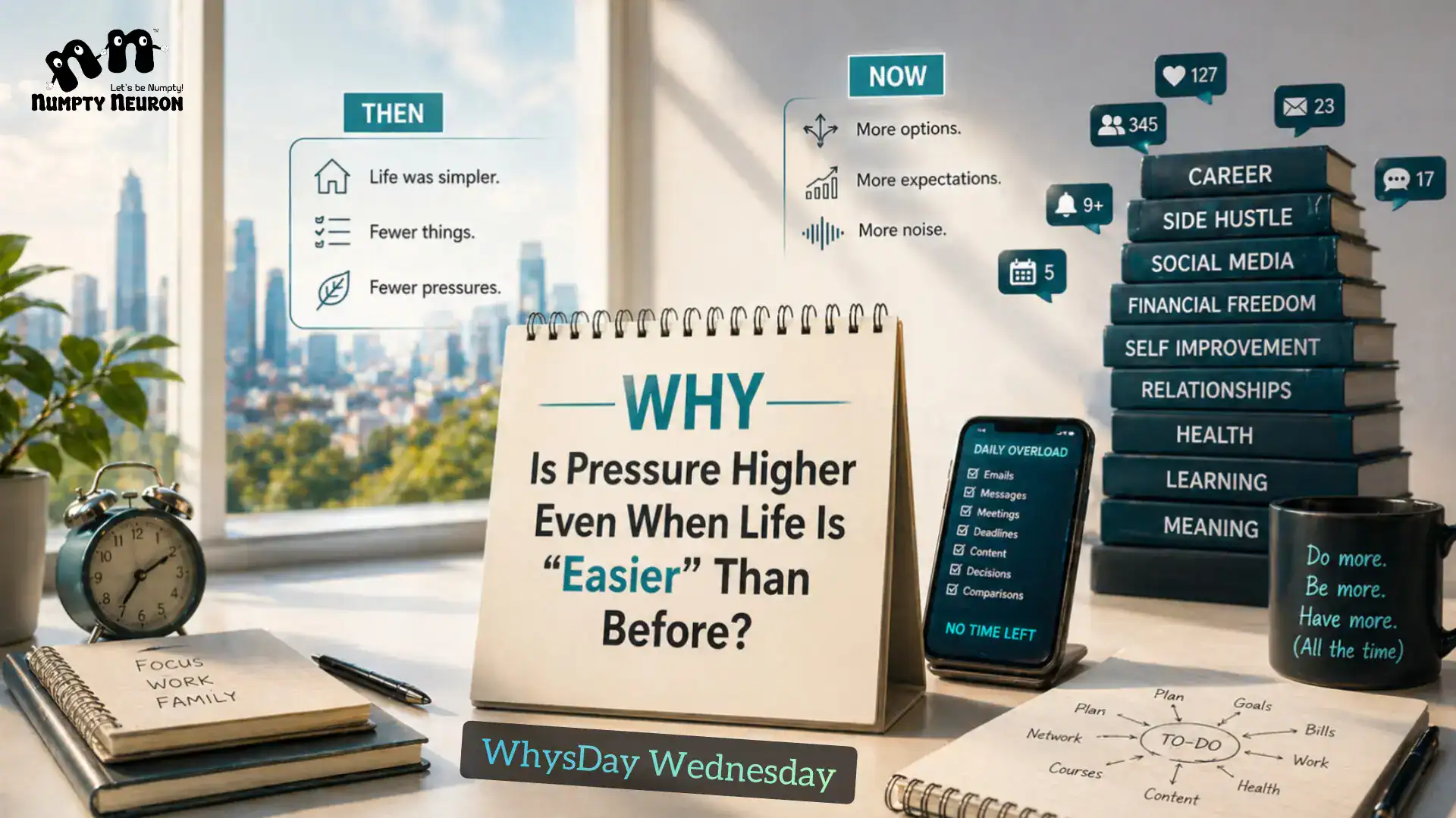
There are too many doors now.
Fifty ways to monetize a skill. A hundred ways to learn. Infinite niches. Constant comparison on LinkedIn. Metrics everywhere. Dashboards measuring performance.
Your brain is overloaded with options.
When the brain can’t confidently choose, it produces vagueness.
Not because you lack ambition, but because committing to the wrong door feels expensive in a fast-moving market.
So instead of choosing badly, you stay in undefined desire.
4. It’s Not About the Job. It’s About Autonomy.
Many professionals today are successful but psychologically dependent.
Dependent on employer validation. Dependent on performance reviews shaped by algorithms. Dependent on engagement metrics to feel visible.
At some point, your nervous system quietly asks:
“Is this my life… or am I performing a version of success?”
That question rarely shows up clearly. It shows up as scrolling fatigue. Irritation. Fantasies about starting over. Sudden attraction to completely different paths.
You don’t necessarily want a different role. You want a different relationship with control.
5. The AI Effect: Searching for Irreplaceable
Even if your job is secure, something subtle is happening.
When AI can perform parts of your cognitive work, your mind starts questioning your uniqueness.
“If this can be automated… what exactly am I building?”
That existential discomfort doesn’t feel dramatic. It feels like mild dissatisfaction. But underneath it is identity instability.
You’re not chasing “different.” You’re searching for irreplaceable. Until you define that for yourself, the restlessness continues.
6. Why You Can’t Explain It (Yet)
Here’s the final truth.
Clarity often comes after movement, not before.
You’re waiting to fully explain what you want before acting. But identity is constructed through experimentation. The brain refines desire through contrast.
In 2026, overthinking feels responsible. But often it’s the fear of social cost.
“What if I pivot and people don’t understand?” “What if I start small?” “What if I outgrow the version of me others are comfortable with?”
So instead of admitting growth tension, you label it confusion.
If you’re feeling this, you’re not lost.
You’re in transition. The structure that fits who you were is no longer fitting who you’re becoming. And that uncomfortable, hard-to-explain tension?
It’s not randomness. It’s reconstruction.
If this resonated, don’t rush to make a dramatic decision.
But don’t ignore it either.
This phase doesn’t need impulsive change; it needs structured reflection. Not more scrolling. No more comparison. Not another random course. What helps here is guided clarity. A space where your thinking is challenged, your blind spots are surfaced, and your next move is built intentionally, not emotionally.
Because when identity is shifting, guessing alone often keeps you stuck longer.
If you’d rather move through this transition with direction instead of noise, explore how we work with professionals navigating exactly this phase. Our Coaching Services
You don’t need to struggle in silence. And you don’t need to figure it all out alone either.


No comments yet. Be the first to share your thoughts!