
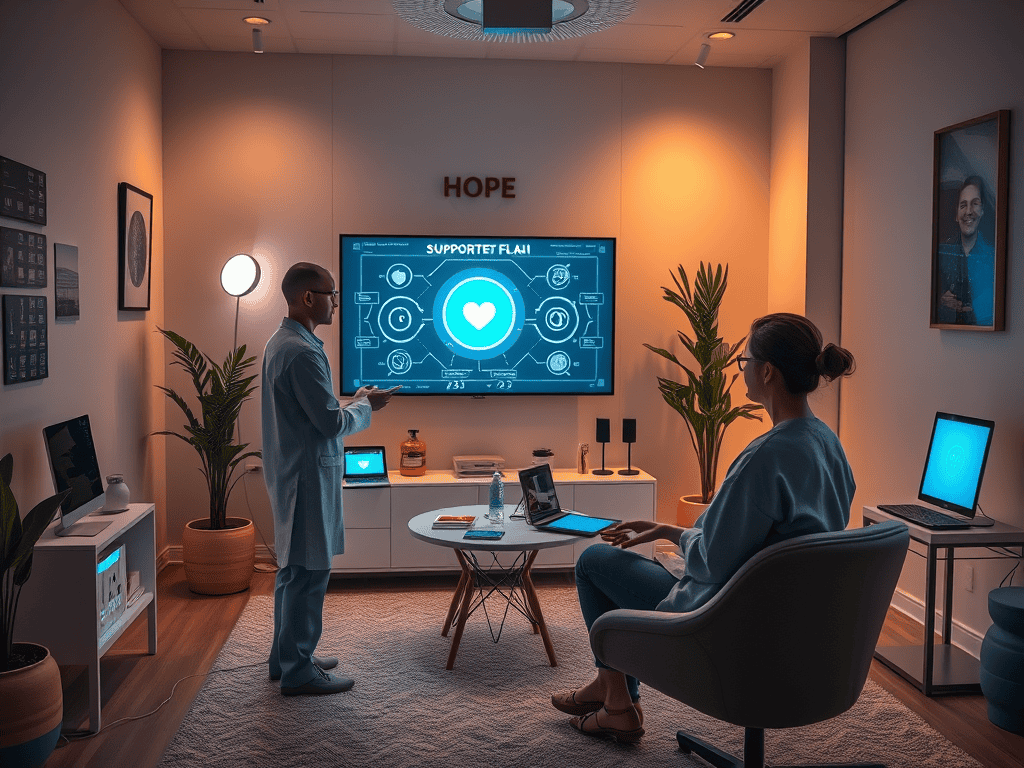
AI’s Potential in Revolutionizing Mental Health Diagnostics and Treatment
Mental health affects millions of people worldwide, yet access to timely, effective care is still limited. At the same time, artificial intelligence is rapidly advancing. AI in mental health is opening new possibilities for earlier diagnosis, more personalized treatment, and continuous support beyond the therapist’s office.
The effect of mental health on people is becoming more and more predominant. Anxiety, depression, stress-related disorders, and loneliness; these issues often go unnoticed or untreated, mainly because of a lack of access to care, stigma, or a shortage of qualified professionals. Many people suffer in silence, simply because either they may not know where to find help or lack the words with which to describe what they feel. Also, they don’t tend to give importance to mental health as they prioritize their physical health. One of the strongest facts is that physical health and mental health are closely intertwined. Providing timely, personalized assistance is challenging for traditional mental health systems because they cannot keep up with the speed of modern technology, which can process and respond in milliseconds.
Meanwhile, technology is stepping in to fill the void, not to replace but rather to extend human care. Once restricted to science fiction, the concept of AI is slowly becoming the silent partner in mental health diagnosis and treatment. It identifies enough early warning signs in someone’s speech or writing, powers chatbots to meet an individual for support at odd hours, or customizes therapy plans to the individual’s needs and progress. AI is revolutionizing mental health diagnostics by enabling early problem identification, providing constant support for individuals, and employing thoughtful and effective methods such as therapy or community support.
The article considers how AI drives changes in the mental health landscape. We will also discuss some of the ethical considerations raised by the technology, including privacy, accuracy, and maintaining the human aspect of care.
In this era of machines that can “listen” and “learn” from human emotions, one might ask how an AI can help an individual feel better and, if so, just how far one can go.
Current State of Mental Health
Mental illness is on the increase globally. Yet the method of identifying and treating it has remained the same over the decades. Now, the majority of the diagnoses are conducted through dialogues between a patient and a mental health expert. They are done via checklists of the DSM-5 (Diagnostic and Statistical Manual of Mental Disorders) manual, which is the American Psychiatric Association’s (APA) handbook used to diagnose and classify mental disorders. Although useful, the tools rely heavily on the ability of an individual to verbalize feelings and on the clinician’s ability to interpret them correctly.
This causes several major issues:
- Symptoms may appear differently to everyone. For instance, two depressed people may have entirely different habits.
- Most individuals shy away from treatment due to stigma.
- There are insufficient professionals with the proper training, particularly in rural or low-income communities.
According to the World Health Organization (WHO), almost 1 in 8 people worldwide suffers from mental disorders, with over 85% going untreated in many low- and middle-income countries.[1] The National Institute of Mental Health (NIMH) also stresses that early intervention is crucial to improving outcomes, but delays in seeking care for mental health are fairly common.[2]
Some standard treatments are talk therapy (such as CBT), drugs (such as antidepressants or mood stabilizers), and lifestyle modifications. Cognitive behavioral therapy (CBT) is a psychometric, goal-oriented, and structured talk therapy that helps to identify and change negative thoughts. The techniques prove effective but usually need recurrent assistance and continuous follow-ups, which not everyone can afford.

Credits: https://www.nimh.nih.gov/health/statistics/mental-illness
In summary, the current system is under stress despite being useful. Lengthy wait times, imprecise symptom descriptions, and restricted accessibility separate people who require mental health care from those who receive it. This is where new opportunities are being presented by technology, particularly artificial intelligence.
How AI in Mental Health Is Changing Diagnostics
It’s difficult to diagnose mental health conditions. You can’t see them on a scan or weigh them with a blood test, unlike physical diseases. That’s where Artificial Intelligence (AI) is now making a significant impact. AI systems are being designed to detect patterns in what we say, how we sound, our expressions, and even our behavior when we’re online or on the phone. For instance, a person with depression may talk slowly or use more negative phrases. AI can detect these cues with startling accuracy.
AI‑Powered Screening and Early Detection
If we say mental illnesses can’t be seen on a scan or tested with blood like physical diseases, we mean they don’t possess the uniform physical markers of sorts: a tumor or a virus would qualify as such. However, AI algorithms detect very subtle patterns in brain scanning data (MRI) that humans may not notice.[4] They are not exactly “proof” of a certain mental illness, but rather small changes appearing in the brain structure or brain activity that tend to be found in association with schizophrenia.
Smarter Brain Scans and Diagnostic Imaging
In other words, what traditional scans do not or cannot categorically portray as a mental illness, what AI, on the contrary, may be capable of analyzing in tons of brain data, is the risk level for a disorder based on these subtle signs. To put it in brief, A doctor cannot spot mental illness in the scan; AI, however, detects subtle patterns that hint at it.
Wearables and Continuous Monitoring of Mental Health
Smartwatches are also contributing. They monitor sleep, heartbeat, and activity levels. Artificial intelligence can review this information to detect changes that could be related to mental health. For example, if a person’s sleep is interrupted and their activity levels suddenly decrease, an app could encourage them to speak to a therapist. The aim is not to substitute for doctors or therapists but to enable them to respond sooner. Through early warning signals, AI can enable mental health professionals to reach individuals in need quickly.
How AI in Mental Health Supports Treatment and Therapy
Once a mental disorder is identified, the next biggest hurdle is securing timely and adequate help. But most individuals face barriers to help, like long wait times, exorbitant costs, or limited access to qualified psychoanalysts. AI is filling in the gaps and playing a role where therapy cannot readily be received.
AI Chatbots and Virtual Mental Health Companions
The chatbot is arguably the most notable application of AI in mental health treatment. These virtual assistants are trained in techniques like Cognitive Behavioral Therapy and are available 24/7. They do this by giving users a safe and supportive environment that allows them to track their moods and express their feelings. Today, millions of people use their phones to manage stress, anxiety, and depression with apps like NHS, Woebot, Wysa, and many more.
| Application | Description | Examples |
|---|---|---|
| Diagnosis & Detection | Identifies mental health conditions early using speech, text, and facial analysis | Kintsugi, Limbic Access, Winterlight Labs |
| Chatbot & Virtual Therapy | Offers real-time, personalized mental health support through CBT and NLP | Woebot, Wysa, Youper |
| Mood & Sentiment Tracking | Monitors emotional states to flag mental health risks using AI algorithms | Ellipsis health, Bearable |
| Remote Monitoring | Provides continuous mental health monitoring via wearables and mobile apps | Mindstrong HealthVenture Empatics’s Embrace 2 Happy Ring |
| Predictive Analytics | Predict mental health crises by analyzing health and behavior data. | Merative (IBM Watson Health) |
Digital Therapeutics, Neurofeedback, and Ongoing Support
AI is not all about chatbots. It’s also personalizing mental health treatment. Because everyone feels mental health uniquely. AI considers how a person acts, feels, and reacts to treatment and recommends the best course of action. This tailored approach can make treatment more successful. Some of the AI tools even assist therapists. They can summarize therapy sessions, point out emotional patterns, or provide recommendations based on how the patient is progressing. This is time-saving and helps in making each session more targeted and beneficial.
Another new field getting noticed is neurotechnology-based therapies. One such example is Prism[6], a system employing AI to direct brain stimulation for disorders such as Post-Traumatic Stress Disorder (PTSD) and depression. It employs real-time brain signals to enable individuals to retrain their thought processes without the use of medication. For individuals who do not respond to conventional treatments, this may be revolutionary.
Case Studies and Ongoing Research
AI is not just a sci-fi concept anymore; it’s already being tested and used in actual mental health environments. Throughout the globe, scientists and healthcare professionals are implementing pilot programs and studies to determine the effectiveness of AI solutions for improving people’s emotional well-being. Case studies reveal what AI can accomplish, where it still needs to be enhanced, and how it could influence the future of mental health treatment.
Case Study 1: Woebot’s Influence on Mental Wellbeing[7]
In this study, half the sample was interacting with Woebot, whereas the other half received a depression informational ebook from the National Institute of Mental Health (NIMH). Just after two weeks, Woebot users felt that they were feeling better, suggesting that short check-ins with AI over days can provide genuine emotional support and significantly influence one’s mood.
Case Study 2: Limbic Access with the NHS[8]
The UK’s National Health Service (NHS) piloted Limbic Access, an AI system that assists with mental health referral management. It categorizes patients according to the urgency of their case and supports them in completing intake questionnaires. In pilot clinics, this AI application improved matching patients with appropriate therapists more quickly and lowered assessment waiting times by 25%.
Ethical Concerns and Limitations of AI in Mental Health
While AI has great promise for improving mental health care, it also presents important issues that we must address. We must use AI with caution, compassion, and a strong sense of ethical duty since mental illness includes highly personal aspects of people’s lives.
1. Data Security and Privacy
Data related to mental health is extremely sensitive. Voice recordings, journal entries, and emotional patterns are among the personal data that AI systems frequently collect. Patients might not always understand the type of data being gathered or how it will be stored. The risk of such information being misused, stolen, or disclosed is real. Without clear privacy laws and strict security measures, people’s trust in AI systems can quickly decline.
For instance, it has been discovered that certain mental health applications exchange user information with outside advertisers without providing clear notice. This is a significant issue in relation to exploitation rather than assistance.
2. Bias in AI Algorithms
Since AI learns from the data it is provided, biased or insufficient input will also affect the AI’s output. The datasets used to train many AI systems don’t accurately reflect all population groupings. This implies that certain individuals, such as those from different age groups, genders, or ethnic backgrounds, may get unfair or inaccurate evaluations and assistance.
It has been demonstrated that many AI emotion-detection algorithms misread facial expressions from various racial groups.[9] A study revealed that commercial systems such as FaceReader and DeepFace were better at identifying Western faces than Eastern ones, particularly when it came to negative emotions. This raises questions about their potential application in mental health treatment.
3. Risk of Extreme AI Dependence
AI technologies are not meant to replace human therapists; rather, they are meant to support them. However, there is concern that healthcare systems that are overloaded or underpaid might rely too much on AI to speed up or reduce costs. That would reduce the number of human-led treatment sessions and reduce mental health services to checklists.
No matter how advanced AI becomes, a chatbot or algorithm will never be able to replace the empathy, compassion, and individualized attention that a qualified human specialist can provide, especially to someone experiencing extreme emotional distress. It is dangerous and insufficient to rely too much on simple technological solutions to handle complex mental health difficulties.
Summary
AI in mental health is not a replacement for human care, but a powerful ally. It’s creating new opportunities for quick, easily accessible, and customized care, from early detection to individualized therapeutic support. Providing everyday support, recognizing distress signals, and enabling individuals to take charge of their mental health on their terms can bridge the gaps left by human services. However, the enormous potential also entails enormous responsibility. We must make sure AI enhances human care rather than replaces it as we embrace technology in our emotional lives. Building technologies that assist without inadvertently harming others would require ethical design, data protection, cultural sensitivity, and ongoing human monitoring.
Mental health is very human, complex, and unique to each individual. AI must be based on empathy, justice, and openness if it is to be a part of that journey.
Are you curious about the ways that technology is changing mental health? For more straightforward, intelligent, and entertaining discussions about neuroscience, artificial intelligence, and NLP, don’t forget to follow Numpty Neuron. Stay Curious! Be Numpty!
Reference:
- “WHO Special Initiative for Mental Health. https://www.who.int/initiatives/who-special-initiative-for-mental-health“
- “NIMH. (2023). RAISE-ing the Standard of Care for Schizophrenia: The Rapid Adoption of Coordinated Specialty Care in the United States. https://www.nimh.nih.gov/news/science-updates/2023/raise-ing-the-standard-of-care-for-schizophrenia-the-rapid-adoption-of-coordinated-specialty-care-in-the-united-states“
- “NIMH. Mental illnesses. https://www.nimh.nih.gov/health/statistics/mental-illness“
- “Brain Sciences. (2024). Decoding Schizophrenia: How AI-Enhanced fMRI Unlocks New Pathways for Precision Psychiatry. https://doi.org/10.3390/brainsci14121196“
- “Front. Psychiatry. (2022). Advances in Using MRI to Estimate the Risk of Future Outcomes in Mental Health – Are We Getting There?. https://doi.org/10.3389/fpsyt.2022.826111“
- “Institute For Advanced Psychiatry. Prism for PTSD — Providing New Hope for Trauma Sufferers. https://www.psychiatryfortworth.com/blog/prism-for-ptsd-providing-new-hope-for-trauma-sufferers“
- “JMIR Ment Health. (2017). Delivering Cognitive Behavior Therapy to Young Adults With Symptoms of Depression and Anxiety Using a Fully Automated Conversational Agent (Woebot): A Randomized Controlled Trial. https://doi.org/10.2196/mental.7785“
- “Limbic. (2023). AI mental health chatbot that predicts disorders becomes first in world to gain Class IIa UKCA medical device status. https://www.limbic.ai/blog/class-ii-a“
- “Front. Psychol. (2023). The cross-race effect in automatic facial expression recognition violates measurement invariance. https://doi.org/10.3389/fpsyg.2023.1201145“
- “Biological Psychiatry: Cognitive Neuroscience and Neuroimaging. (2021). Artificial Intelligence for Mental Health Care: Clinical Applications, Barriers, Facilitators, and Artificial Wisdom. https://doi.org/10.1016/j.bpsc.2021.02.001“




No comments yet. Be the first to share your thoughts!