
Part 3 – The Language of Machines: Understanding NLP in the Modern World (An In-Depth NLP Series)
Part 3: Data Visualization and Text Representation in NLP
Welcome back to our NLP journey! So far, we’ve dived deep into the fascinating world of Natural Language Processing (NLP). We have explored key concepts like Natural Language Understanding (NLU) and Natural Language Generation (NLG). Additionally, we have looked into crucial data processing techniques. We’ve broken down complex topics like tokenization and normalization. We even tackled the little details like removing stop words, handling emojis, and filtering out URLs and hashtags. We also explored stemming, text augmentation, and much more to get our data clean and ready.
In Case You Missed It: Previous Parts of Our NLP Journey
- Part 1: The Building Blocks of NLP – Exploring NLU, NLG, and Core Elements
- Part 2: From Raw to Refined – Data Processing
But the journey doesn’t stop there! In this part, we’re leveling up by delving into new and exciting topics like text representations, Zipf’s Law, and data visualizations. These techniques bring words to life in the digital world and are key to unlocking deeper insights from text.
Ready to dive deeper? Let’s get started!
Did you know that 90% of the world’s data is unstructured, with much of it being text? Natural Language Processing (NLP) helps to process human language from search engines predicting what you would search for to chatbots understanding the customer’s queries.
So, how do machines understand text? Here comes Text Representation Techniques: The foundation of NLP that transforms text into structured data.
Text Representation
Text representation plays a vital role in Natural Language Processing by transforming text into data for analysis. Without these Text Representation Methods, it would be difficult for algorithms to process the unstructured human language. The most common Text Representation Methods Include
- Term Frequency (TF)
- Document Frequency (DF)
- Treebank Annotation
- Dependency Parsing
- Word Clouds
Text representation is a way to convert text into a form that computers can
understand and work with. Since computers don’t inherently understand words, we transform them into numbers or structured data that preserve their meaning. This process is crucial for any Natural Language Processing (NLP) task, enabling machines to analyze, learn from, and make sense of language effectively.
Term Frequency (TF)
Term Frequency (TF) is defined as the number of times a term appears in a document divided by the total number of words in that document. This will analyze a piece of text and capture the important words.
Formula:
$$Term Frequency (t) = \frac{Number \,of \,times \,term \,t \,appers \,in \,a \,document}{Total \,number \,of \,words \,in \,a \,document}$$
Example:
Suppose we have a document containing text similar to the following:
“NLP enables machines to perceive text. NLP is one of the building blocks of AI.”
If “NLP” occurs 2 Times in a document of 10 words, then:
TF(“NLP”)= 2⁄10=0.2
Applications of Term Frequency in Natural Language Processing:
- Used in TF-IDF ( Term Frequency-Inverse Document Frequency) to assign importance to the words.
- To understand keyword relevance in SEO for search engines.
- Also helps in the classification of documents & clustering of text.
Document Frequency (DF)
Document frequency of the words represents the frequency of documents for that word. So basically it is a number of documents containing a particular word. So for example particular word is present in one document 5 times and not present in any other document, then its DF will be 1. And if another word is present once in 5 different documents, then its DF will be 5.
Document Frequency (DF) is a text representation method in Natural Language Processing (NLP) that measures the frequency of documents in a given collection that contain a specific term. In short, it assists in the determination of the significance of a word in a particular document in relation to the entire corpus.
Document Frequency Calculation Example:
Assuming the corpus contains three documents, as shown below:
- Doc 1: “Machine learning and NLP are transforming AI.”
- Doc 2: “NLP is widely used in AI applications.”
- Doc 3: “Machine learning improves AI performance.”
Going further, we can calculate the DF for the above three documents
| Term | Appears in Doc1? | Appears in Doc1? | Appears in Doc1? | Document Frequency |
| NLP | ☑️ | ☑️ | – | 2 |
| AI | ☑️ | ☑️ | ☑️ | 3 |
| Learning | ☑️ | – | ☑️ | 2 |
Results:
“AI” is present in all three documents, which means that it is a very common term in the given corpus of data (DF = 3).
“NLP” is present in two papers, so it is somewhat popular but not everywhere (DF = 2).
“Learning” also has the same DF = 2, which suggests that it is there in the texts, but in not all of them.
Treebank Annotation
Treebank Annotation is a structured depiction of sentence patterns in a corpus where syntactic and grammatical constructions are tagged to enable the machines to discover human language. It functions as the best dataset for carrying out natural language processing methods like parsing, POS tagging, and syntactic analysis.
Interestingly, treebanks represent groups of sentences that come with various types of linguistic structures like syntax trees, phrase structures, and dependencies, which are used for the analysis.
What’s the point of Treebank Annotation?
- NLP models are trained to understand the structure and grammar of the sentence.
- It is applied in the process of machine translation, syntax parsing, and assisted AI grammar checkers.
- It integrates with the search engine to make it simpler to understand natural language queries.
- Raises the bar for sentiment analysis and chatbot responses.
Dependency Parsing
Dependency parsing is a syntactic analysis technique that describes the grammatical structure of a sentence as a directed graph. In the graph, each of the words is linked to another word by grammatical relations.
Basic Concept:
- Words in a sentence depend on each other, forming a tree structure.
- The main verb is the ROOT of the sentence.
- Other words are connected as subjects, objects, modifiers, etc
Why is Dependency Parsing Important?
- Makes it easier for search engines to read natural language queries.
- Facilitates the functioning of chatbots and voice assistants such as Alexa, Siri, and Google Assistant.
- Increases the accuracy of machine translation.
- Cut sentiment analysis and opinion mining as well.
- Used in sentiment analysis and opinion mining.
Word Clouds
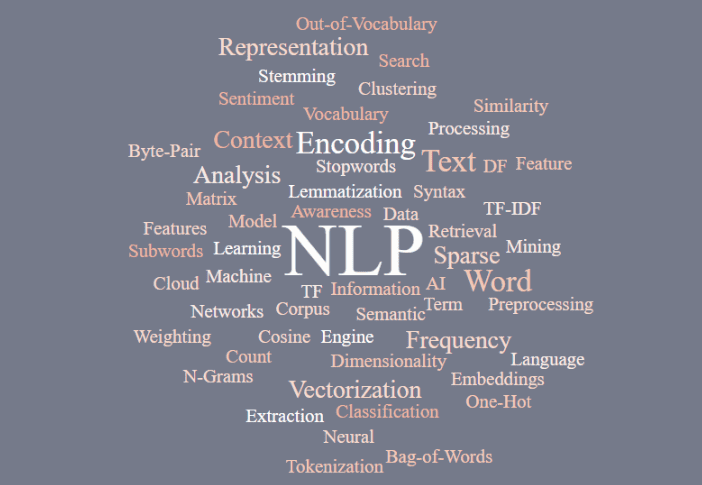
A word cloud is a visual chart that shows text data, with the size of each word proportional to its frequency in the dataset. Word clouds provide insight into the most commonly used words in a text and are used to analyze key terms in a document, which is useful for text analysis, SEO optimization, and sentiment analysis.
Key Idea:
The high-frequency words are shown more visibly, and the opposite is true for the low-frequency ones.
It provides a catchy way for users to read information from the graphic.
What Do These Pictures Mean (Word Clouds)?
- A simple method to figure out a dataset’s most frequent words in the shortest possible time.
- The use of a word cloud is especially beneficial for experts in the field of SEO, enabling them to spot the most valuable keywords.
- It is immensely popular among marketers to judge consumer views from both quantitative and qualitative perspectives, some of which include social media, surveys, and brand monitoring.
- This technique is invaluable in the condensation of long pieces of literature, such as reports, articles, books, etc.
Example
Text Input:
“Words lead, ideas rule the world. The simple words can show the entire image of text by shaping in the form of clouds.”
Resulting Word Cloud:
The words of high frequency such as “language” and “skills” are larger in size.
The words of low frequency such as “master” and “vocabulary” are smaller in size.
Zipf’s Law
Zipf’s Law is an interesting linguistic law that concerns itself with the overall organization of a natural language. It claims that in a sufficiently large corpus of text, the frequency of any word is inversely proportional to its rank in the frequency table. This suggests the most common words (for example, “the” in English) appear approximately twice as often as the second most common, three times as often as the third most common last, and so forth. The outcome is a power law distribution where a relatively small selection of words is extremely common while the majority are infrequent.
Example: This means that in a book, the phrase “the” may crop up around 10,000 times, while “of” comes in at 5,000, and “and” at a whopping 3,300. Specialized words such as “conundrum”, on the other hand, may only crop up once.
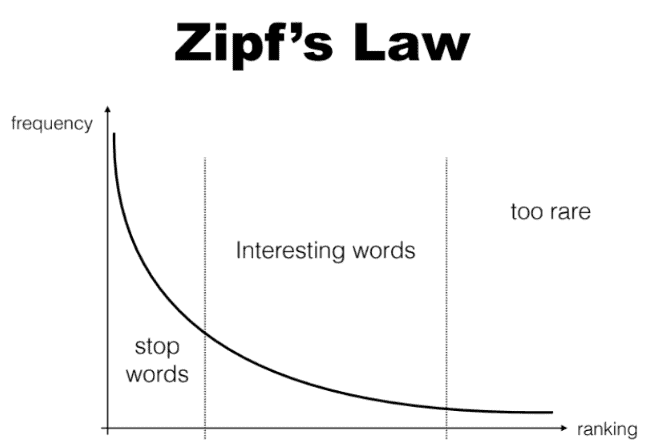
Credits: https://www.ngcm.soton.ac.uk/2021/07/07/natural-language-processing-in-python/
This law is especially relevant in the case of NLP since it emphasizes that most words do not occur often enough, making tasks such as text modeling, vocabulary selection, and even the most basic word usage challenging. A few ways to combat this inequality are stop words removal, subword modeling, and smoothing. In every case, understanding Zipf’s Law helps develop better language models where efficiency in terms of storage and computation alongside precision is required.
Summary
Everything starts with text understanding in NLP, and this understanding cannot exist without representing the text. Text representation in NLP serves as a bedrock for understanding language in computational terms. Term frequency (TF) and document frequency (DF) work to codify the importance of a word concerning being in certain documents. From here, a further analysis can occur. Treebank annotation gives syntactic trees labeled with grammatical roles of syntactic elements in a sentence, and dependency parsing shows relations among words to capture meaning in sentences. Word clouds are a visual tool that depicts high-frequency terms for a glance into the text’s content. A statistical expression, normally referred to as Zipf’s law, states that a few words occur very frequently, whereas a large number of words are hardly ever used, thus providing insights into the pattern that could serve as a basis for performance-based language processing.
Are you still excited? Follow Numpty Neutron for mind-tickling drops of NLP wisdom; that’s where deep learning collides with simple visualizations. Dive smart, stay curious!
💬 Join the Conversation
📖 NLP Blog Series
The NLP Blog Series is a structured, multi-part journey into the fascinating world of Natural Language Processing (NLP) — the field of AI that enables computers to understand, interpret, and generate human language. From the basics of text processing and machine learning techniques to advanced applications like chatbots, sentiment analysis, and large language models, this series breaks down complex concepts into easy-to-follow, practical guides. Whether you are a beginner curious about how machines understand text, a student diving into AI, or a professional exploring NLP applications, this series is designed to give you a step-by-step foundation along with real-world insights.
Part 4 of 9



No comments yet. Be the first to share your thoughts!